Study figure and data
Estradiol study: protected-hip procollagen I mRNA
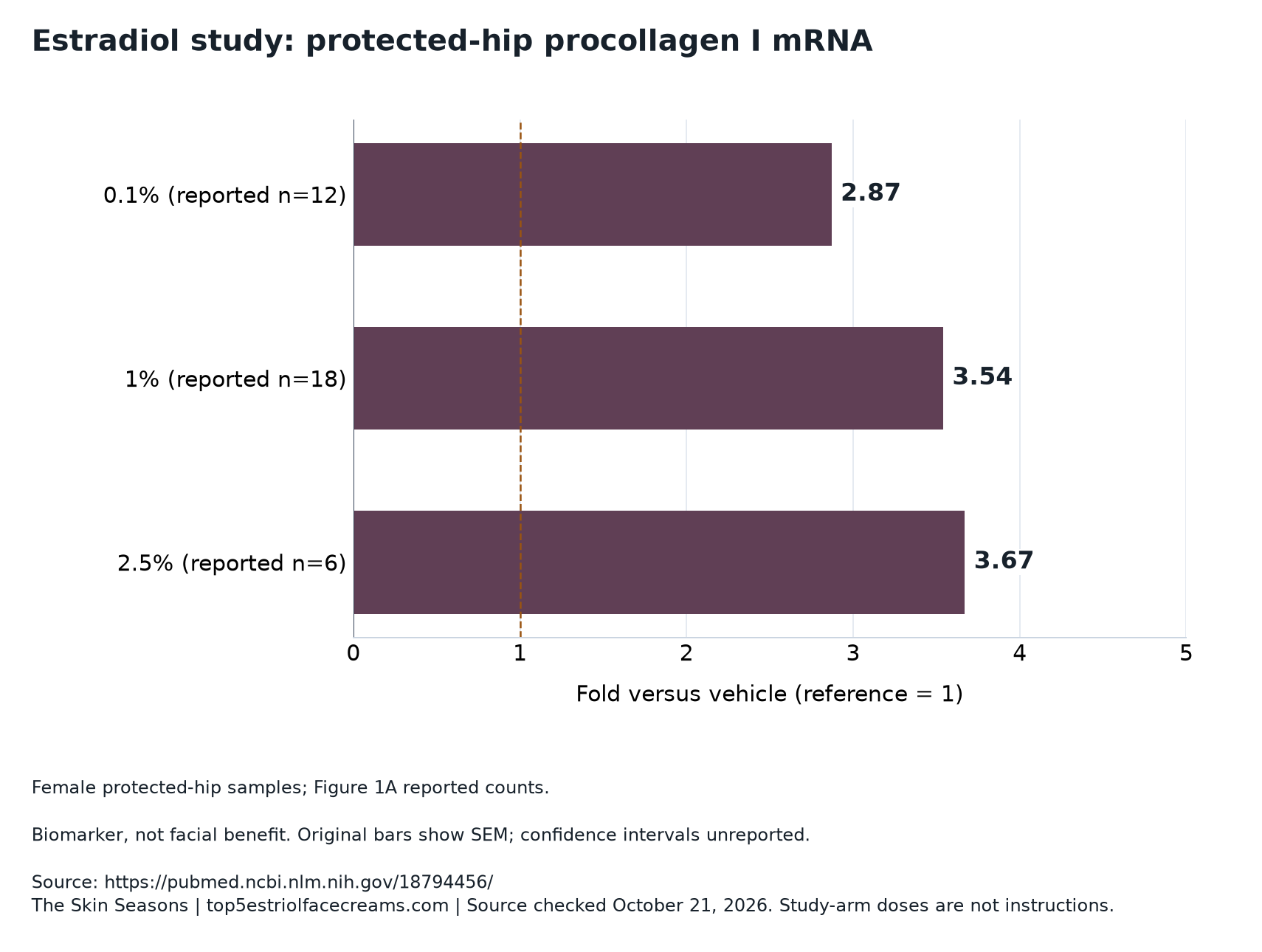
Female protected-hip samples; Figure 1A reported counts.
Biomarker, not facial benefit. Original bars show SEM; confidence intervals unreported.
Download chart (PNG)Download data (CSV)Download vector chart (SVG)
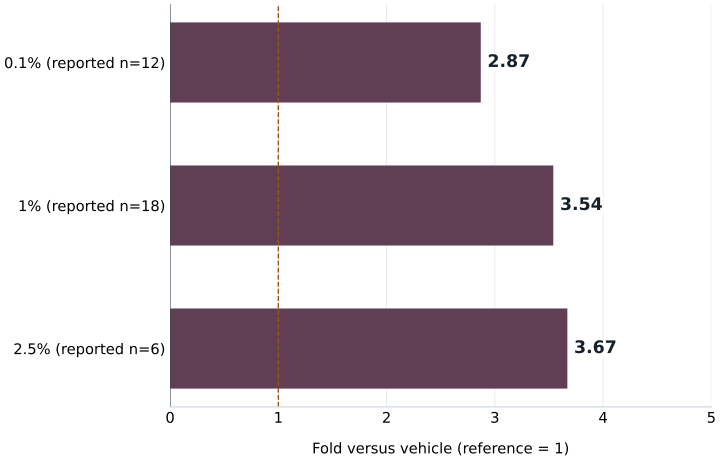
| Historical estradiol concentration | Reported value |
|---|---|
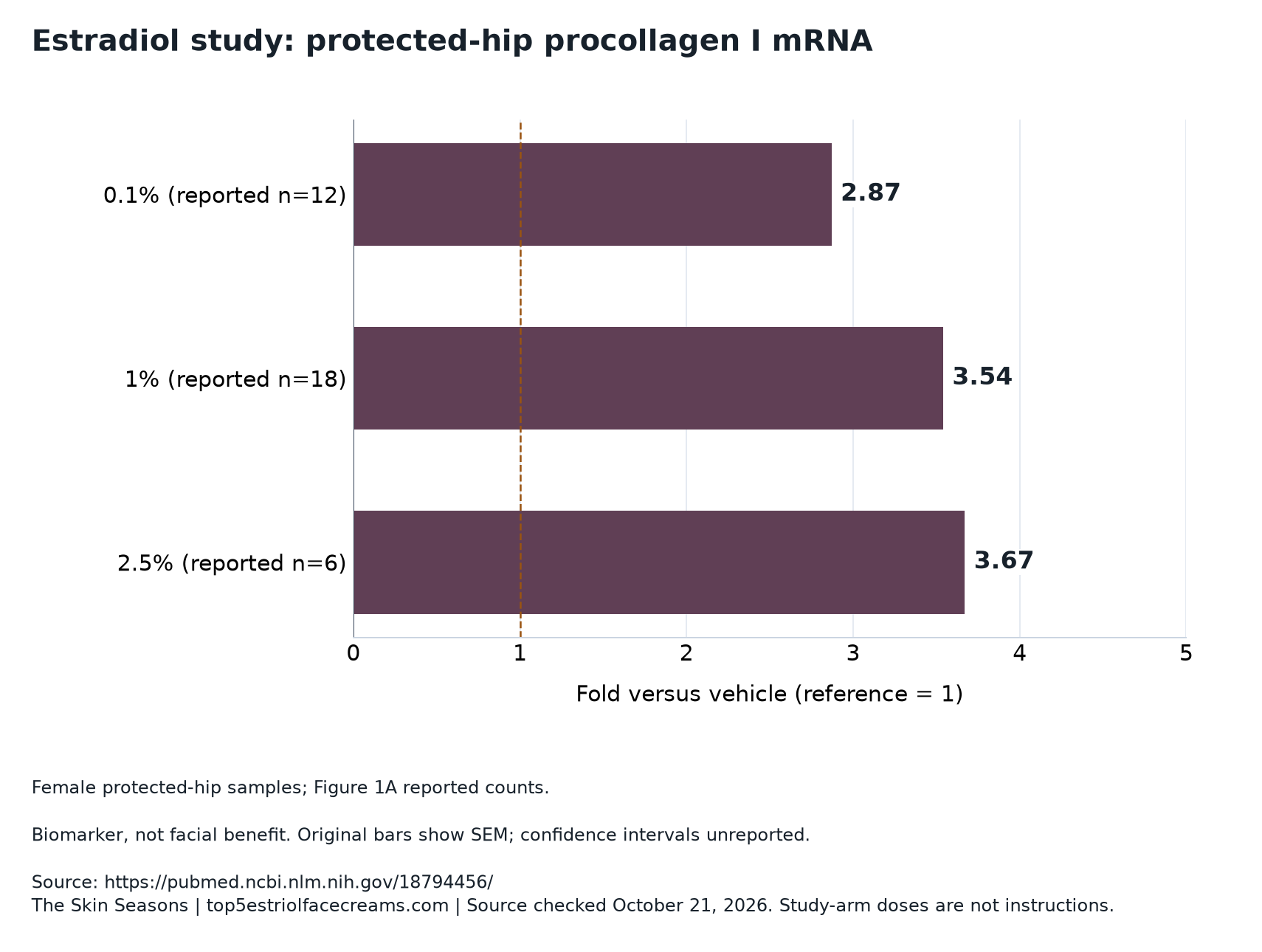
| 0.1% (reported n=12) | 2.87 |
| 1% (reported n=18) | 3.54 |
| 2.5% (reported n=6) | 3.67 |
Find the experiment behind the headline
The 2008 paper involved 70 people averaging 75: weeklong hip/forearm vehicle comparisons, and two-week facial before/after observations (five women/five men). Facial procollagen did not increase detectably. Figure/table counts conflict (18/17); first protein figure/text doses conflict (0.01%/0.1%). Historical 0.2% facial estradiol raised serum levels. Pfizer partly funded research; Voorhees received Pfizer consulting payments.
The first reading task is organizational: make a separate entry for each experiment instead of assigning the headline enrollment to every result. Our guide to what topical-estrogen studies examined provides a broader starting point. For a focused assessment, write down the tissue, comparison, observation period and outcome next to one another. If any of those changes, you have a different scientific question, even when the author list and publication remain the same.
In our interpretation, the crucial distinction is between a treatment contrast and a change over time. A vehicle comparison asks what differs when the active ingredient is contrasted with its comparison preparation. A before/after observation asks what changed between observations. Time itself remains part of the latter comparison. Also, a vehicle control does not establish random allocation: that requires a documented assignment method. These are properties of the design, not judgments about the researchers.
Keep the person distinct from the specimen
Imagine an explicitly hypothetical experiment with twelve volunteers, each contributing two treated skin sites and three laboratory readings per site. That produces seventy-two readings, but not seventy-two independently enrolled people. Repeated measurements can improve knowledge of a specimen while still sharing the same person, exposure and biological background. Before reading a statistical test, ask which of those levels the analysis treats as independent. The answer determines what the sample count means.
A paired comparison can use a person as their own reference. Conceptually, the analysis first asks how the two conditions differ within that person, then examines those differences across people. Simply treating every laboratory reading as an unrelated observation would answer a different question. Conversely, a study with separately enrolled groups has no automatic within-person match. Neither arrangement is universally superior; each needs analysis consistent with how the observations were collected.
For an original reading worksheet, give enrollment, treated sites, collected specimens and analyzed outcomes separate columns. Leave an entry unknown when the report does not establish it. Counts from different rows should never be added until overlap has been resolved. This simple discipline is especially useful when a figure contains several concentrations: a label beside each bar is not, by itself, a census of unique participants.
Read a fold value from its reference
A fold value is a ratio: the measured quantity divided by its reference quantity. One represents equality with that reference. In a hypothetical example, a laboratory signal increasing from two units to four is twofold, equivalent to a 100% increase. Calling it a 200% increase would confuse the final level with the change. The same ratio follows from twenty to forty units, despite a very different absolute difference.
This arithmetic does not establish what the units mean biologically. Nor does it establish how much change a person would notice. A ratio can summarize a molecular assay without providing a conversion into wrinkle depth, comfort or perceived improvement. Reading it well requires keeping both the denominator and the endpoint visible. Comparing ratios from different assays without checking their reference values can create an apparent ranking that the measurements do not support. An error bar also needs its own label: standard error describes uncertainty in an estimated mean, rather than variability among individuals. It is not interchangeable with a confidence interval.
Our interpretive preference is to write the absolute quantities beside a ratio whenever the report makes them available. When it does not, retain the ratio and its stated reference rather than reconstructing missing values. The illustrative table shows why. Its numbers are teaching examples only; none represent participants, skin measurements or outcomes from the cited trials.
| Starting and final values | Calculation | Interpretation |
|---|---|---|
| 2 units to 4 units | 4 ÷ 2 = 2-fold | 2 units added; 100% increase |
| 20 units to 40 units | 40 ÷ 20 = 2-fold | 20 units added; 100% increase |
| 4 units to 2 units | 2 ÷ 4 = 0.5-fold | 2 units removed; 50% decrease |
Separate the steps between a signal and appearance
Think of a proposed explanation as a chain of questions. Did a biological signal change? Did a relevant protein measurement change? Did tissue structure change? Did appearance change in a way participants valued? These questions are related, but answering one does not automatically answer the next. An assay may be an informative intermediate measurement without being a substitute for the final outcome. The scientific task is to test the connection rather than assume it.
For example, suppose a future study found a larger molecular signal after treatment but no detectable difference in blinded photographs. That hypothetical combination would not make the laboratory finding false. It would mean the two measurements describe different parts of the problem. Conversely, an appearance difference would not alone identify which biological pathway produced it. Mechanism and benefit require compatible evidence, rather than one being inferred solely from the other.
This distinction also helps when comparing categories in the estriol-versus-moisturizer guide. Our interpretation is that an ingredient category should not decide which endpoint counts. If the question is comfort, assess comfort. If the question is a visible change, require a suitable appearance comparison. A molecular result can motivate that comparison, but it cannot supply the missing observation or establish the size of a patient-relevant benefit.
Handle conflicting labels without repairing the data
An inconsistent label presents two tasks: preserve what the report says and decide which conclusions remain usable. Neither task requires guessing what the authors probably intended. In our reading method, the disputed value is marked unresolved, and any calculation that depends on choosing one version is withheld. Other measurements can still be examined if their identity does not rely on that choice. Uncertainty should remain attached to the affected result.
Suppose, hypothetically, a methods table lists fifteen participants while a figure lists sixteen samples. Several explanations are possible: a repeat specimen, an updated dataset, a different analysis set or a typographical error. Listing possibilities is not evidence that any occurred. A correction, protocol or clarified dataset could settle the issue. Until then, selecting the explanation that makes a preferred conclusion easier would introduce information the reader does not possess.
The same approach applies to a concentration label: do not use an uncertain mapping to construct a dose-response recommendation. A sound summary can state that a question remains open without discarding the whole paper. Funding disclosures belong alongside this appraisal, but they do not resolve a labeling discrepancy or prove that a result is biased. The practical standard is traceability: another reader should be able to identify every assumption required by your interpretation.
Compare sites without assigning a cause
Finding a detectable change in one comparison and an undetectable change in another does not establish that the treatment effects differ. The direct question is the difference between those effects, with its own uncertainty. In a hypothetical paired-site experiment, one could estimate a treatment-minus-control change at each site and then compare those contrasts. Two separate significance labels are not a replacement for that calculation.
Even a supported difference between sites would leave a second question: what explains it? Location can travel with other characteristics, including the exposure procedure, baseline tissue condition, sampling method or observation time. Naming a plausible explanation is useful for generating a hypothesis, but it does not isolate that explanation experimentally. A study designed to investigate it would need to specify which factor changes and which competing factors remain comparable.
For a facial-cream comparison, our practical inference is to prioritize measurements collected at the relevant site under a relevant protocol, while using other tissue research to frame questions. That does not require declaring one body site scientifically irrelevant. It requires describing the additional step needed before applying its estimate elsewhere. Likewise, nonsignificance should prompt questions about precision and design; it should not automatically become a claim that an effect is impossible under every future protocol.
Decide whether a newer study repeats the question
The 2026 conference pilot randomized 90 postmenopausal women aged 50–60 to estriol 0.3%, estradiol 0.01% or placebo for twelve weeks; 86 completed. Its primary assessment used investigator ratings, with participant assessments and biomeasures considered separately. Alloy Health funded it. These details do not establish the identity of a tested retail product. Our companion analysis of the pilot comparisons examines that report directly.
A replication question needs more precision than whether two studies concern estrogen and skin. Our proposed comparison starts with the molecule, formulation, tissue, population, control, duration and endpoint. A deliberate change in any one could answer a valuable new question. It would nevertheless need to be described as a changed question, rather than treated automatically as confirmation or contradiction. Multiple differences make it especially difficult to attribute a disagreement to one feature.
For this pilot, the abstract reports no participant-rated efficacy difference between groups and no tolerability issues on the reported scales; it supplies no confidence intervals. Our interpretation is that agreement between observers, instruments and participants should be examined rather than presumed. Such disagreement can guide the next study: specify which outcome matters, how it will be measured, and what result would count as a meaningful improvement before inspecting the data.
Read older facial observations at their available depth
The indexed 1996 abstract describes 59 preclimacteric women receiving estradiol 0.01% or estriol 0.3% for six months, with biopsies in ten. It reports appearance and tissue findings, but its combined 61–100% wrinkle-depth/pore wording does not provide separate estimates suitable for a clean comparison. Randomization and a vehicle comparator are not established in that abstract. Prolactin increased. Full funding disclosures are not available from this indexed account.
Our interpretation is that an abstract can establish that an investigation occurred without providing every quantity needed to reproduce its analysis. When several outcomes share one range, do not allocate its extremes to individual outcomes. First ask for the endpoint definitions, denominators, baseline values and variability. A range lacking those elements cannot responsibly become a precise forecast of an individual appearance change or a new graph of selected outcomes.
The smaller biopsy subset raises a separate reading question: which participants contributed to which measurement? A laboratory outcome and a clinical outcome need not have identical analysis sets. Before connecting them, look for matched observations and an analysis of their relationship. The explanation of facial estriol creams supplies category context; it does not fill missing trial methods. Historical observations can motivate a better study without already satisfying the requirements for that study’s intended claim.
Give absorption and safety their own questions
The indexed 1993 abstract describes seventeen women, averaging 57.1 years, using estradiol or estriol facial ointment for three months. Serum hormone measures and vaginal-smear findings showed no significant change. The accessible abstract does not establish randomized allocation or a vehicle comparator; complete funding information is unavailable. This is a report about particular measurements over a particular interval, not a general guarantee about every hormonal exposure.
To evaluate a claim of no meaningful absorption, our proposed standard would require the sampling schedule, measurement sensitivity and a prespecified definition of what difference matters. A test that fails to detect a difference does not by itself meet an equivalence standard. Likewise, a study designed around a laboratory measurement cannot automatically estimate uncommon clinical events. Exposure, tolerability and longer-term outcomes deserve separately stated questions, appropriate comparisons and sufficient observation.
FDA states that no estriol-containing drug is approved and has not established estriol as a safer estrogen. Those regulatory facts do not supply a numerical risk estimate for a particular facial cream. For a clinical discussion, the facial-estrogen safety questions help organize what to ask about the exact preparation and personal circumstances. Research concentrations identify historical study conditions; they are not instructions to apply another estrogen medicine to the face.
Specify the comparison a finished product would need
Our proposed next-study worksheet begins with a concrete claim, such as a visible improvement that participants consider worthwhile. It then specifies a finished preparation, a justified control, an allocation method and a measurement plan before choosing a headline. A suitable design would also explain missing-data handling, distinguish its principal outcome from exploratory analyses, and prespecify how uncertainty will be reported. These are proposed requirements, not descriptions of a completed trial.
Documentary comparison remains a different task. The CoreAge Rx Time Out review and Alloy M4 review are places to inspect product descriptions and commercial terms. Those links do not identify either product as the preparation in the collagen experiments or confer its results on either provider. Our editorial approach keeps the study-to-product match explicit rather than treating a shared ingredient word as sufficient.
FDA explains that compounded medicines are not approved generics and do not undergo its premarket approval review for safety, effectiveness and quality. Facility registration is not product approval. The compounding questions guide develops that distinction. In our interpretation, a useful product assessment therefore keeps three records separate: the research evidence, the identity of the actual preparation, and the terms of the service supplying it. Strong documentation in one record does not complete the others.
| Question to settle | Comparison to specify | What the answer would clarify |
|---|---|---|
| Is a molecular signal reproducible? | Same endpoint, reference and collection method | Whether the original scientific contrast recurs |
| Is a visible difference meaningful? | Blinded assessment plus participant-defined relevance | Whether a measured change matters to users |
| Does the result apply to a finished cream? | Documented formulation and exposure matching the question | Which preparation the estimate actually describes |
| What uncertainty remains about safety? | Defined exposure, follow-up and clinical outcomes | Which risks the design can reasonably evaluate |
Questions about the evidence
Does a larger fold value mean a better facial cream?
No direct ranking follows from the arithmetic alone. In our interpretation, a comparison needs a common endpoint, reference, exposure and uncertainty estimate before even asking about practical importance. A product ranking adds another requirement: evidence that the tested preparation matches the product being compared. A ratio is a measurement summary, not a complete clinical decision.
Why not add every figure’s sample count together?
Because the count could refer to overlapping people, sites, samples or analysis sets. Our reading method first identifies what each number counts and whether the groups overlap. If that cannot be established, the total remains unknown. Addition is easy; establishing that the things being added represent separate enrolled participants is the scientific work.
Can an ordinary moisturizer be judged by a different outcome?
The outcome should follow the question, rather than the prestige of an ingredient. For an original comparison concerned with comfort, specify a comfort measure and an appropriate control. For an appearance question, specify an appearance outcome. A favorable result on one should not be silently substituted for the other, regardless of whether the preparation contains a hormone.
What would make a negative result more informative?
A clearly defined comparison, a justified sample size, a meaningful effect threshold and a precise estimate would help. Our interpretation distinguishes an estimate compatible with both benefit and no benefit from one that rules out a prespecified worthwhile difference. Without that distinction, the word negative can conceal several scientifically different situations and does little to guide a subsequent study.
What should a reader bring to a discussion about a facial prescription?
Bring the exact product description, the claim you want evaluated, and the outcome that matters to you. Ask which evidence addresses that combination, what uncertainty remains and how the clinician would assess suitability. This turns a broad conversation about collagen into a specific question without treating historical experimental concentrations as personal application directions.
Editorial assessment
The strongest reading of this evidence is a comparison map, not a universal verdict on facial estrogen. In our assessment, the useful next step is to name the claim, locate the experiment that addresses it, and make each remaining assumption visible. A reproducible tissue finding, a meaningful appearance difference and a well-characterized finished preparation are distinct achievements. They can support one another, but the link between them has to be demonstrated rather than supplied by an attractive graph.
Research access and limitations
This analysis distinguishes recorded study findings from original methodological interpretation and hypothetical examples. Access to the older facial reports is limited to indexed abstracts; no complete protocols or funding disclosures are claimed for them. Historical research does not establish individual suitability, a commercial product’s outcomes or long-term safety. Unresolved labels remain unresolved, and unreported uncertainty is not reconstructed.