Study figure and data
Facial cream pilot: investigator hydration ratings
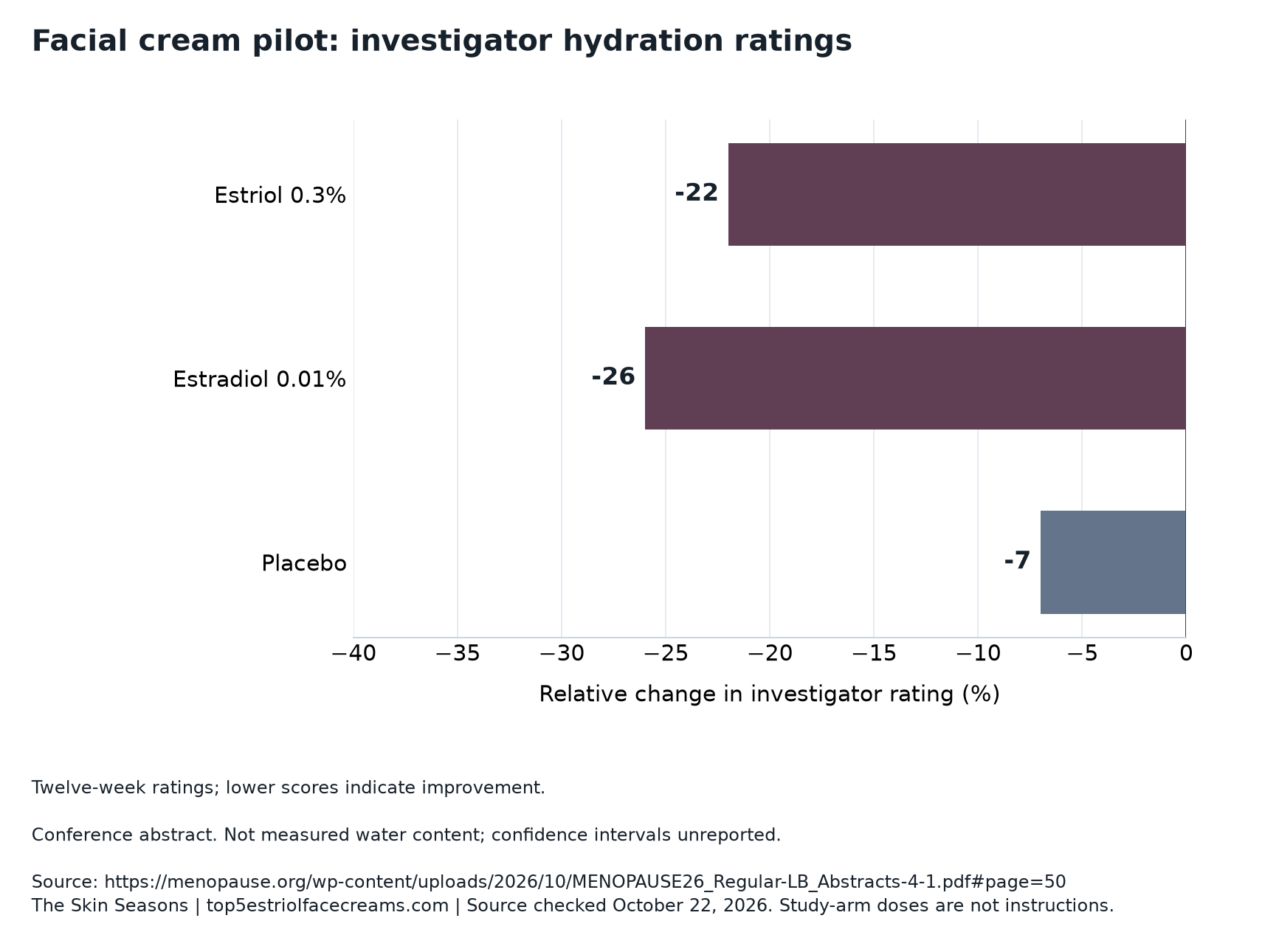
Twelve-week ratings; lower scores indicate improvement.
Conference abstract. Not measured water content; confidence intervals unreported.
Download chart (PNG)Download data (CSV)Download vector chart (SVG)
| Historical study arm | Reported value |
|---|---|
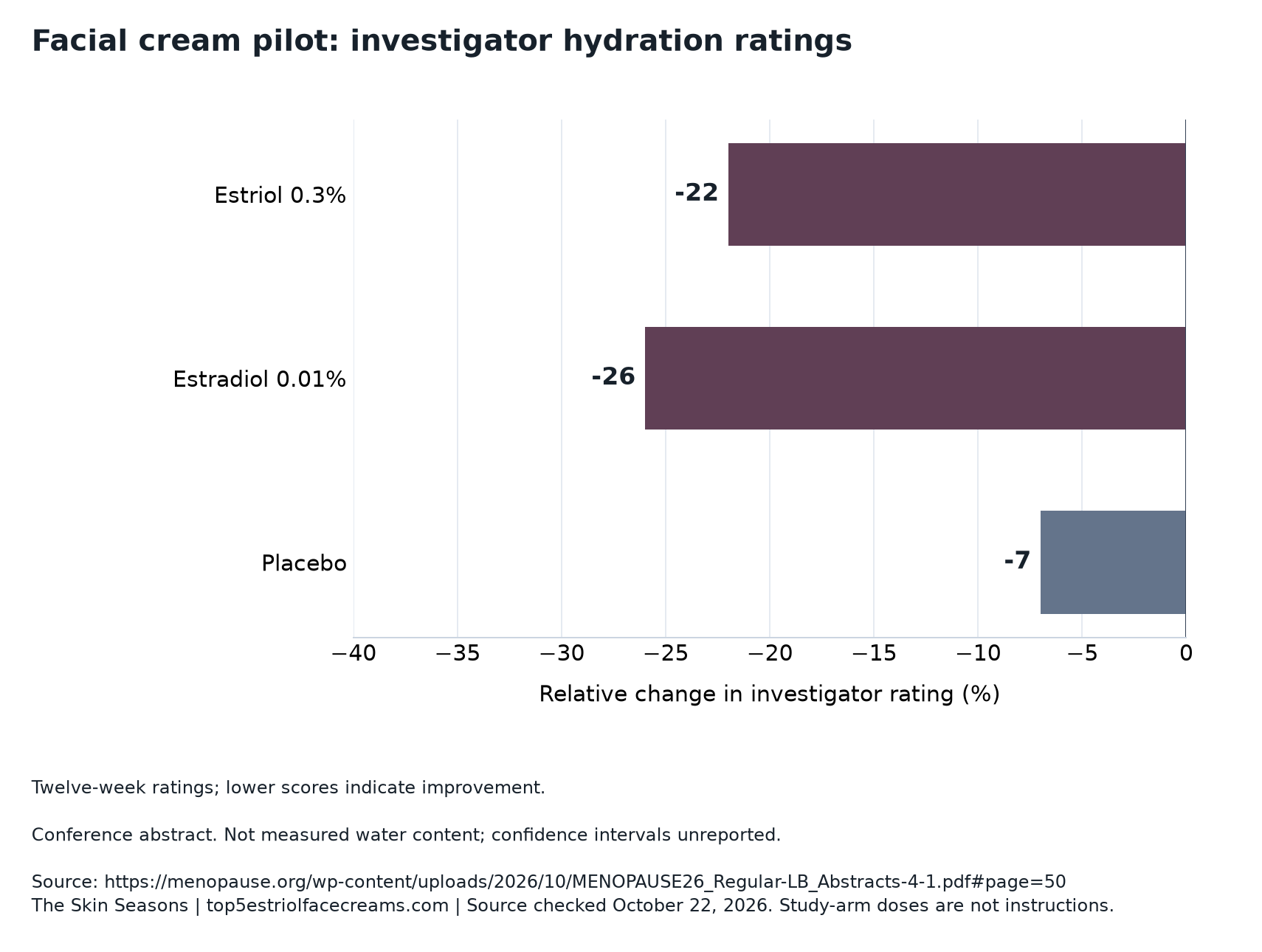
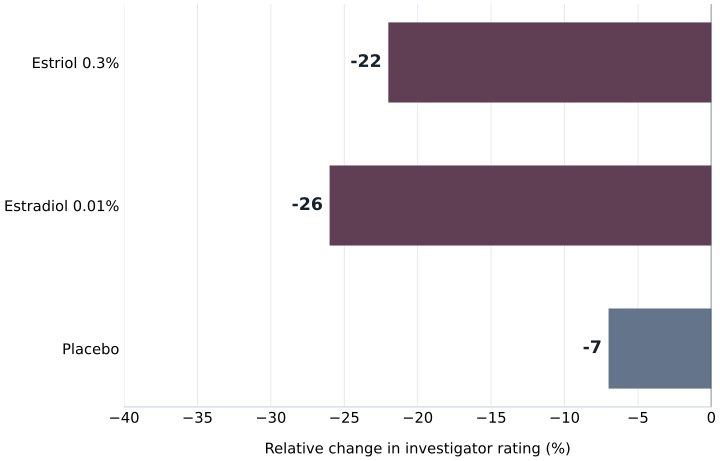
| Estriol 0.3% | -22 |
| Estradiol 0.01% | -26 |
| Placebo | -7 |
Start with the question a comparison can answer
Our interpretation starts by separating three questions: did a group change, did its change differ from a control group, and did one active treatment outperform another? Those questions require different calculations. Improvement within a group incorporates everything that happened during observation. A control comparison is intended to separate the effect of assignment from changes that also occur without the active ingredient. An active comparison asks a further question about the difference between treatments.
Consider an invented study in which a discomfort score improves by two points with cream A and one point with its control. The within-group improvement is two points; the difference in improvement is one. Describing either number simply as the treatment effect would hide the comparison being made. The example is arithmetic, not an estimate for estrogen creams. It also illustrates why a before-and-after photograph cannot by itself stand in for a controlled result.
Before reading a claim, write its implied comparison in a sentence. Against baseline, against a matched control, against another prescription or against ordinary skincare are distinct possibilities. Our guide to what topical-estrogen studies studied provides a starting point for keeping those questions attached to the appropriate research.
Keep the rating scale attached to the percentage
Primary investigator ratings used a 0–4 scale. An ordered rating places observations into categories; it does not automatically establish that every step represents an equal biological difference. Our reading therefore keeps a percentage change in a rating attached to that rating. Moving between categories is not interchangeable with adding water to skin, changing tissue mass or counting people who notice improvement.
For a hypothetical arithmetic example, a score changing from two to one decreases by half, while a score changing from four to three decreases by one quarter. Both move one numerical point. The percentages differ because their starting denominators differ. These invented scores do not describe participants in the pilot, and they do not establish that averaging categories is the right statistical method. They show why a relative change needs its original scale and starting value to be interpretable.
A reader might care instead about how many people crossed a meaningful threshold. That would require a threshold defined in advance, individual classifications and a denominator for the assessed population. Group-level changes cannot be converted into those counts. Nor can a score change define the improvement an individual person should expect. Keeping those quantities separate prevents a visually persuasive chart from silently becoming a promise about response.
Two placebo comparisons do not create a head-to-head result
A useful original interpretation rule is to draw a line between the two groups named in a claim. If the claim compares A with B, evidence comparing A with control and B with control still needs an analysis of A against B. Subtracting two displayed summaries may suggest a descriptive difference, but it does not provide the uncertainty around that difference. Sample variability and the way the estimates were calculated matter.
Imagine two entirely hypothetical treatment comparisons. One has a larger estimated improvement but wide uncertainty; another has a smaller improvement measured more precisely. The second could have a smaller P value. Ranking treatments by those P values would confuse strength of evidence against a specified statistical hypothesis with size of benefit. A P value is neither a measure of how important a change feels nor the probability that a product is the best choice.
For a direct comparison, look for its estimate, the analysis used and a confidence interval describing precision. If a study instead aims to show similarity, its acceptable difference should be justified before examining results. Failure to establish a difference is not itself evidence that two treatments are interchangeable. These are separate study questions even when all the creams appear together in one figure.
| Question | Analysis needed | What it does not establish |
|---|---|---|
| Did one group change? | Its follow-up compared with its baseline | The contribution of treatment assignment |
| Did assignment improve the outcome? | Treatment change compared with control change | Superiority over another active cream |
| Which active treatment performed better? | A direct active-versus-active estimate with uncertainty | Interchangeability when no difference is detected |
| Are treatments sufficiently similar? | A justified similarity margin and appropriate analysis | Similarity from an ordinary nonsignificant test |
Observer judgments and measurements answer different questions
An investigator’s judgment, a participant’s experience and an instrument reading describe different aspects of a treatment. Our interpretation treats them as complementary questions rather than interchangeable confirmations. A person may value comfort or convenience; an observer may score visible characteristics; an instrument may quantify a particular physical signal. Agreement would be informative, but one cannot assume that agreement merely because all three appear under a heading such as skin health.
A practical reading exercise is to rewrite every endpoint as a complete sentence: who assessed what, using which method, at what time? That wording makes a change of measurement easier to notice. For example, a hypothetical decrease in a dryness rating should not become a measured increase in water content during retelling. The adjective objective also cannot replace information about calibration, repeatability or the conditions under which an instrument was used.
Unspecified methods should remain unspecified rather than being completed with familiar technical labels. A broader comparison can still distinguish the purposes of different measures. Our guide to estriol and ordinary moisturizers helps keep product categories separate while the evidence is evaluated on its own terms.
Ask which observations contribute to an estimate
Our next interpretive question is not simply how many people entered a study, but which observations enter each calculation. An enrollment count, a completion count and an endpoint analysis count serve different purposes. A participant might finish follow-up yet lack one usable measurement. Conversely, an analysis might include information collected before a participant left. Without the analysis definitions, those possibilities should remain possibilities rather than assumed explanations.
Consider an invented trial with missing final scores concentrated among people who found a cream uncomfortable. A complete-case analysis could differ from one that accounts for that missing information. If missing scores instead arose from an unrelated instrument fault, the implications might differ again. This example identifies questions for a report; it does not assign either pattern to the pilot. The reason for missingness and the sensitivity of conclusions to assumptions both matter.
An informative full report would connect allocation, follow-up and analysis in a participant flow diagram, then explain how incomplete observations were handled. It would also show how much the estimate changes under reasonable alternative assumptions. Precision is another concern: more observations can narrow uncertainty without correcting a systematically biased measurement. Asking about both analysis membership and measurement quality is therefore more useful than treating a single participant total as a quality score.
Read the outcome family before selecting a result
Fine-line, wrinkle, pore and tone contrasts were nonsignificant. Our interpretation is to read an outcome family together rather than select whichever label sounds most attractive. When many questions are tested, the plan for deciding which results carry confirmatory weight matters. A result found while exploring several measurements can be useful for planning further work without having the same status as a clearly prioritized test.
As an original reporting exercise, imagine listing every planned outcome before viewing any result. Give each an outcome definition, a time point and an intended comparison. Then ask which was designated to answer the central question and how the remaining tests were handled. That exercise makes it harder to let a memorable finding quietly replace the question the study was designed to address. It also exposes whether a composite phrase combines measurements with different interpretations.
When a numerical table and a narrative interpretation disagree, the disagreement belongs in the assessment. A reader should not silently choose the more favorable version or assume a typographic correction. Resolving it requires clarification from the investigators or a fuller report. Until then, the appropriate conclusion is narrower than a claim assembled from every positive-sounding sentence. The same principle applies when an abstract’s brevity leaves the hierarchy of outcomes difficult to reconstruct.
Use tissue studies to test a different part of the argument
The 2008 estradiol paper examined tissue biomarkers across skin sites, not a facial-cream ranking. Its protected-hip findings do not establish visible facial benefit. That distinction provides a useful bridge to our analysis of collagen findings at different skin sites. A laboratory measurement can support a biological question while leaving a consumer-facing appearance question unanswered.
Our original interpretation is to map the steps between a mechanism and an outcome someone values. A change in a molecular signal would first need to connect to a relevant tissue change, then to a meaningful clinical effect under the proposed conditions. Evidence at one step does not automatically fill the later steps. This is not a reason to dismiss mechanistic work; it identifies what that work contributes and which experiment should follow.
Cross-study comparisons need the same discipline. If body site, preparation, duration and outcome all differ, a disagreement cannot isolate one of those differences as the cause. A useful follow-up would hold selected features constant while testing the proposed explanation. Pooling unlike measurements into a single claim can conceal precisely the scientific question that makes the studies interesting: which part of the pathway transfers to a new setting, and which part still needs demonstration?
Separate tolerability, absorption and long-term outcomes
The pilot reported no tolerability issues on its scales; serum differences versus placebo were nonsignificant. In the 1993 indexed abstract, 17 women had no significant hormone or vaginal-smear changes over three months. The 1996 indexed abstract reported increased prolactin. These are distinct observations, not a combined certificate of safety. Complete disclosures for those older studies are not established from the indexed abstracts.
Our interpretation separates three questions. Tolerability concerns what participants or investigators notice during exposure. Absorption concerns whether and how much a substance reaches the circulation. Long-term clinical safety concerns consequential outcomes over an appropriate duration. An assessment designed around one question cannot simply be renamed to answer another. A blood result also needs context about sampling, assay performance and the range of changes the study could reliably distinguish.
To support negligible exposure, a study would need a defensible threshold and measurements capable of testing it; a nonsignificant difference alone does not supply either. To assess uncommon later events, its population and follow-up would need to suit that purpose. These are requirements for stronger evidence, not estimates of risk from a particular cream. Our questions before a facial-estrogen prescription provides a separate place to organize the personal discussion with a qualified clinician.
A trial result and product approval answer separate questions
FDA states that compounded medicines do not undergo its premarket approval review for safety, effectiveness and quality. They are not FDA-approved generics. This regulatory distinction should remain attached to product descriptions even when a historical study is scientifically interesting. It does not by itself estimate how well a particular formulation works, and a trial result does not change a finished product’s approval status.
Our editorial interpretation is to keep two records when comparing creams: an evidence record and a product record. The first describes what was tested and what the results support. The second identifies the actual formulation, dispensing route and terms being offered. Connecting them requires evidence of a match; matching an ingredient name is only the beginning of that inquiry. A sponsor’s identity is also a different kind of information from a verified identity of the tested formulation.
An exact product question can therefore remain unresolved even when an ingredient question has useful evidence. Readers can use the compounded-estriol guide to organize the documentary questions. The aim is a traceable comparison: each conclusion should point either to the appropriate clinical observation or to a clearly identified product document, with neither kind of record being asked to substitute for the other.
What would make the next comparison more informative?
Our proposed next-step study would begin with the decision it is intended to inform. A comparison of finished creams should identify those preparations precisely and prespecify a direct contrast. Its main outcome should reflect a meaningful difference, with measurement procedures, analysis membership and uncertainty reported clearly. Participant experience could add a separate perspective, while systemic measurements would need their own justified sampling plan. These are design proposals, not details asserted about an existing trial.
The practical counterpart is to inspect product records without treating them as clinical proof. The CoreAge Rx Time Out review and Alloy M4 review are places to examine documentary terms. Neither link establishes that the listed product is the pilot preparation. Reading the research and the product information together is useful only when the boundary between them stays explicit.
| Design decision | Information to specify | Reason it matters |
|---|---|---|
| Finished preparations | Identity, formulation and relevant application conditions | Defines what a result could apply to |
| Main comparison | Which two groups and which outcome | Prevents a different question replacing the intended one |
| Meaningful difference | An advance justification in the outcome’s units | Connects statistical precision with practical relevance |
| Missing observations | Analysis rules and sensitivity analyses | Shows dependence on incomplete follow-up |
| Safety question | Exposure measures, clinical outcomes and suitable follow-up | Keeps distinct questions from being collapsed into one claim |
Questions about the evidence
Would two favorable placebo comparisons justify choosing one cream?
They could motivate a direct comparison, but they do not settle it. The relevant estimate compares the active treatments with each other and expresses the uncertainty around that difference. An individual decision also asks different questions from a group-level statistical test. Our interpretation is to keep the scientific comparison explicit before considering documentary terms or a clinician’s advice.
Can a rating percentage become a response rate?
No arithmetic conversion supplies that answer. A response rate requires a definition of response and a count of people meeting it out of a specified population. A percentage change in a group rating describes a different quantity. Even an attractive average or summary could coexist with varied individual experiences; describing that distribution requires participant-level information or appropriate reported summaries.
What should a reader do with an unexplained error term?
Preserve the uncertainty about its meaning. A standard deviation describes dispersion of observations, while a standard error describes uncertainty in an estimate; neither label should be supplied by guesswork. A confidence interval requires its own interpretation and calculation. Requesting a definition is more defensible than drawing error bars that appear precise but have no documented basis.
Can several small studies substitute for one relevant study?
They can contribute different pieces of an argument, but relevance depends on the question. Combining a tissue experiment, a clinical rating study and a short systemic observation does not automatically produce a direct comparison of finished creams. Our synthesis keeps each contribution visible, then asks which remaining uncertainty requires a better matched design rather than simply another citation.
What evidence would change this assessment most?
A complete report clarifying methods would improve interpretation. Independently replicated results with a justified main outcome, direct treatment contrasts, informative uncertainty estimates and suitable safety follow-up would address additional questions. Product-specific conclusions would also require a documented connection to the tested preparation. This is an editorial standard for stronger evidence, not a prediction about what further studies will show.
Editorial assessment
The useful reading is comparison by comparison: identify the groups, retain the original measurement and ask what the uncertainty permits. Our assessment does not turn favorable findings against a control into an active-treatment ranking, or a short physiological observation into a broad safety conclusion. The strongest next step is evidence that answers the intended finished-cream question directly. Until then, product documentation and scientific findings can inform the same investigation while remaining distinct kinds of evidence.
Research access and limitations
The 1993 and 1996 studies are assessed from indexed abstracts. The 2008 article has a fuller source review. This article provides original methodological interpretation, not a product equivalence test or individualized prescribing advice.